

Every day, executives are inundated by a tsunami of white papers, industry reports, and articles. Call it “thought leadership,” call it marketing slop, whatever; in 2026 it just never stops. Some of it is useful; a lot is not. In this flooded information environment, an article or report must make its case for claiming the reader’s time within seconds. Anything more and your target executive will assuredly bail.
Here are five techniques to ensure your thought leadership doesn’t just land, but commands.
1. Use a High-Impact Lede to Seize Attention
The traditional introduction is too slow. By the time you’ve set the scene, your executive reader has moved on to the next article. Today, you need to say everything necessary to capture your reader’s attention up top, in what journalists have long called (and spelled) the “lede.”
Your lede needs to pinpoint the stakes, and explain why the reader should care, right now – all in the first few sentences. Then it anchors the stake in numbers, specifically the X% or $Y of opportunity or risk. Finally, it puts the bottom line up front (BLUF). (BLUF was originally an acronym for a military messaging protocol that ensured the vital message was delivered immediately in case a transmission was interrupted.)
The traditional lede: “In today’s increasingly complex and volatile global market, many organizations across various sectors are re-evaluating their long-standing operational frameworks. As supply chain disruptions become more frequent and severe, leadership teams need to optimize their logistics networks to avoid potential setbacks and ensure long-term stability.”
Why it fails: This is “throat-clearing.” It uses 50 words to state a general truth that the reader already knows. It lacks a “so what” and provides no data to justify the time spent reading it.
The high-impact lede: “Supply chain latency costs APAC life science firms an average of $2.4M per quarter. Shifting to a decentralized regional model by Q3 recaptures 18% of this margin and sidesteps the projected June logistics bottleneck.”
Why it works: It identifies a specific pain point ($2.4M), a clear solution (decentralized model), and a measurable result (18% recovery). It commands attention by providing an immediate ROI for the reader’s time.
2. Build a Structure for the Scanners
This should not come as a shock: Executives don’t read thought leadership; they scan it for what speaks directly to their interests and current situations. This is very important for SMEs to understand. Putting a ton of effort into elegant prose is a waste of everyone’s time. No one’s gonna read it. Better to put that effort into building a structure that can let your executives scan easily and then delve into the details they actually care about.
Here’s how you do it:
- The Header Layer. If a reader only sees your title and subheads, they should still be able to know what’s coming. In this article, for example, the phrase after the title’s colon tells the reader to expect five techniques for capturing attention and the subheads tell them what those five are.
- The Signpost Layer. Use bolded lead-ins or subheads to make your article’s structure more accessible. To signal the type of thinking required, use labels like “The Strategic Shift” or “Immediate Requirements” to let your reader categorize the information before he or she processes the full text.
- The Data Layer. Uses lists, numbered or bulleted, to isolate and thereby highlight complex variables or steps. This allows for the quick mental indexing of facts that would otherwise be buried in dense paragraphs. This list of three layers makes it easy to scan.
The “One-Idea” Rule
Every paragraph should contain exactly one idea. If you find a “but,” “and,” or “moreover” in the middle of a paragraph, consider whether you are diluting its impact. Short, punchy paragraphs (like this one) are easier to digest during a commute or between meetings and help ensure that your message survives the day’s ineluctable distractions.
3. Use High-Signal Exhibits to Explain Complexity
If a concept requires more than a paragraph to explain, it may belong in an exhibit. Exhibits can provide a narrative shortcut to conveying complex data without asking someone to wade through surrounding text. Here’s an example from a consulting firm.
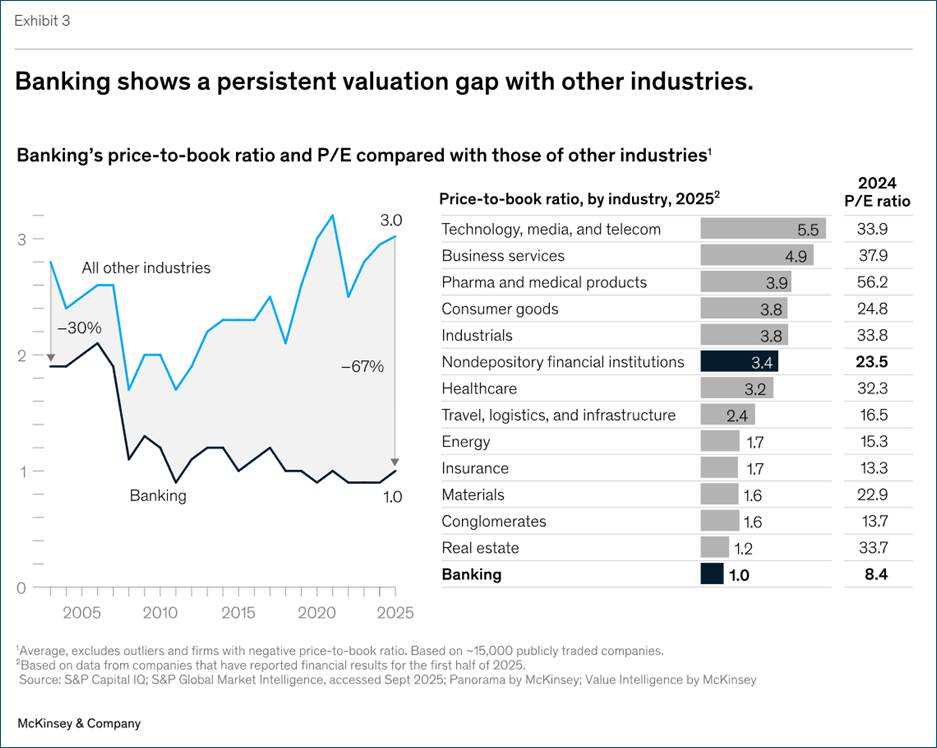
It uses a grammatically complete title (or “action title”) that summarizes the exhibit’s takeaway. Many organizations and academics would use the subhead, “Banking’s price-to-book ratio and P/E compared with those of other industries,” as the title. That’s accurate, but it leaves the reader to do the work of figuring out the message.
4. Enforce a “No-Fluff” Mandate
In 2026, professionalism in industry reports is not defined by formal or flowery language. It is defined by clarity and conviction.
Executives value authoritative insight. Phrases like “It appears that,” or “We could see” signal a lack of confidence. Transitioning from tentative language to assertive (and data-driven) statements increases your authority. However, that doesn’t mean being prescriptive; focus on what the data shows rather than telling the reader what to do. (I don’t like being told what to do. Do you?)
- From: “It appears that the market is reaching a saturation point in traditional retail, and we could see a shift toward specialized digital boutiques.”
- To: “Traditional retail margins have contracted by 4.2% year-over-year, confirming a pivot toward specialized digital boutiques as the primary growth engine for the sector.”
Which statement do you trust more?
5. Master Strategic Disruption for Long-Form Reports
For long-form reports and white papers, different readers need different entry points and paths through the material. It’s highly unlikely that anyone will read them front to back, so provide tools that will let busy readers navigate directly to the content most relevant to them by disrupting, or fragmenting, the narrative.
Start with an executive summary or “In Brief” or ROI section that serves as a standalone version of the report.
Within the body, use anchors that cater to specific interests or roles. For instance, a “What this means for the CFO” call-out box could let finance leaders skip technical implementation details, while a CEO box can focus on the high-level strategy, and a CTO box can jump straight to the technical architecture. Other effective tools include “Fast Fact” sidebars for data-driven readers and descriptive navigation that uses active verbs in the table of contents to tell the story before the first page is turned. By making your content skippable, you are actually increasing the likelihood that more of it will be read and used.
Gifting the Ultimate Executive Luxury
In a world of infinite content, the ultimate luxury is time. When you write with brevity and precision, you aren’t just communicating well, you are giving time back to the reader.
Let’s finish with a challenge. Take your last article or report. Cut the introductory word count by 30% and move the primary insight to the first paragraph. If you can do that, you’re ready for 2026.